Motivation动机
Multimodal LLMs are already strong at general image understanding — but they stumble whenever the answer hinges on a small but decisive detail in the image, often producing a "plausible-looking yet wrong" reply. 多模态大模型(MLLM)如今在通用看图说话上已经相当能打,但只要问题的答案藏在图里一小块决定性的细节上,它们就常常翻车——给出一个“看着挺像、其实答错”的回答。
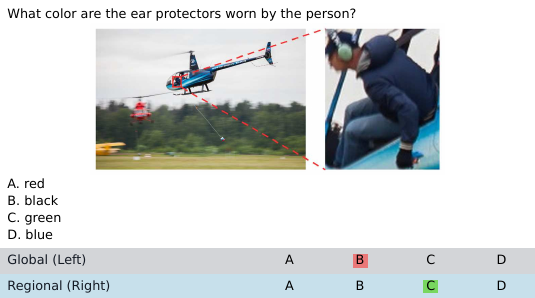
We observe a recurring phenomenon: the same model answers fine-grained questions far more accurately when fed an evidence-centered crop than when fed the full image. The model does not fail to recognize the detail — rather, when that detail is buried among the full image's flood of visual tokens, it cannot focus on the truly relevant evidence. We call this the regional-to-global perception gap. 我们注意到一个反复出现的现象:同一个模型,把“对准关键证据、裁剪放大后的局部图”喂给它,回答细粒度问题的准确率,明显高于喂完整大图。 也就是说,模型并不是“认不出”这个细节,而是当细节淹没在整张图的海量视觉 token 里时,它没法把注意力盯到真正相关的证据上,这道坎叫作区域到全局的感知鸿沟。
A concrete example with Qwen3.5-9B — "What color are the ear protectors worn by the person?": 先直观感受一下这道鸿沟。以 Qwen3.5-9B 为例,问它「图中人物戴的护耳是什么颜色?」:
Recent "Thinking-with-Images" methods equip models with crop-and-zoom visual tools so they can inspect local regions at inference time. This works — but at the cost of repeatedly re-encoding images and re-invoking the model, sharply increasing inference overhead. 最近流行的 "Thinking-with-Images"(边想边看)给模型配上裁剪、放大的视觉工具,让它在推理时主动去抠局部,确实有效,但代价是反复编码图像、反复调用模型,推理开销大幅增加。
Can we bake the benefit of "zooming in on the key region so the evidence stands out" directly into the model through training — so that a single forward pass can exploit fine-grained evidence from the full image, with no inference-time tools at all? 能不能把“放大关键区域、让证据从背景里凸显出来”这个好处,通过训练直接内化进模型,让它一次前向传播就能从整图里用上细粒度证据,而不必在推理时动用任何工具?
Method方法
Since the model is consistently better at the local view than the global one, its behavior on the crop is a ready-made, privileged supervision signal for improving its full-image behavior — let the former teach the latter, internalizing the benefit of "zooming" into a single forward pass. 既然模型看局部一向比看全局强,那么它看裁剪图时的表现,就是一份现成的、可以拿来提升全图表现的特权监督信号——用前者去教后者,把“放大”的收益内化成单次前向传播的能力。
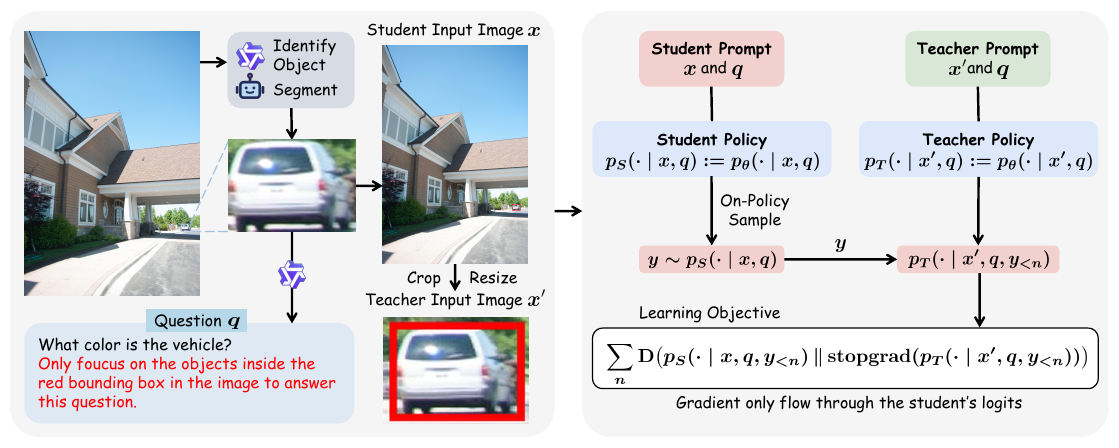
We propose Vision-OPD (Vision On-Policy Distillation), a regional-to-global on-policy self-distillation framework for fine-grained visual understanding. From one and the same model, it instantiates two policies that differ only in what they see: 由此,我们提出 Vision-OPD(Vision On-Policy Distillation),一个面向细粒度视觉理解的区域到全局在线自蒸馏框架。它的精髓在于,从同一个模型里派生出两个“视角不同”的策略:
- Crop Teacher — sees only the evidence-centered, zoomed-in crop; this is its privileged view. 裁剪老师(Teacher):只看那块对准了关键证据的裁剪放大图,这是它的特权视角。
- Full-image Student — sees the complete image. 全图学生(Student):看完整大图。
Training framework训练框架
The teacher conditions on the zoomed crop x', the student on the full image x; both are initialized from the same model. Under the clean local view, the teacher offers the student a "built-in magnifier that needs no extra decoding." For each sample (x, x', q):
老师看裁剪放大图 x',学生看完整图像 x,两者从同一模型初始化。在干净的局部视角下,老师能给学生提供一份“自带放大镜、却不必额外解码”的指导。训练时,对每个样本 (x, x', q):
- The student, conditioned on full image
xand questionq, generates an on-policy trajectoryy. 学生看着全图x和问题q,生成回答轨迹y。 - At every position of
y, the student (full image) and teacher (crop) each give a next-token distribution over the same prefix. 对y的每个位置,学生(看全图)和老师(看裁剪图)在相同前缀下各给出下一 token 的分布。 - Minimize the token-level divergence between the two. 最小化两者在 token 级别上的散度。
- Gradients flow only to the student; the teacher is a fixed target (stop-gradient). 梯度只回传给学生,老师作为固定目标(stop-gradient)。
Because the training prefix is the student's own generation, the train/inference state distributions match — avoiding the compounding "prefix-mismatch" error of off-policy distillation. And because every token receives a meaningful gradient, training never stalls even when a whole batch happens to be all-correct or all-wrong. 因为训练前缀就是学生自己生成的序列,训练和推理的状态分布对得上,避开了离线蒸馏里“前缀对不上、误差越滚越大”的毛病;又因为每个 token 都拿到有意义的梯度,哪怕一批样本恰好全对或全错,训练也不会停摆。
Data synthesis数据合成
A fully automatic pipeline builds triples (x, x', q) from unlabeled images — only about 6.2K in total:
我们用一条全自动流水线,从无标注图像里造出三元组 (x, x', q),总共合成约 6.2K 条:
- Detect and segment objects in the original image, picking tiny-area regions
Rmost likely to hold fine-grained evidence. 对原图做物体识别和分割,挑出面积占比很小(最可能藏着细粒度证据)的区域R。 - Generate a question
qanswerable "from that region alone." 让模型给每个区域生成一个“光看这块就能答”的问题q。 - Overlay the region's bounding box back onto the full image with a spatial constraint (e.g. "only focus on the object in the red box") to form the student input
x. 把区域的边界框叠回原图,再加一句空间约束(比如“只关注红框里的物体”),得到学生输入x。 - Crop and zoom the region by 2× to form the teacher input
x'. 把这块区域裁剪、放大 2×,得到老师输入x'。
The same question is posed under both views; the gap between them is exactly the signal self-distillation learns from. 同一个问题,在两种视角下各问一遍,两者的差距就是自蒸馏要学的信号。
Key design choices关键设计
- Divergence objective: generalized Jensen–Shannon divergence JSD (β=0.5), better than pure forward or reverse KL. 散度目标函数:用广义 Jensen–Shannon 散度 JSD(β=0.5),效果好过纯前向 KL 和反向 KL。
- Top-K logits distillation (K=100): distill only the top-100 logits plus a tail-probability term — saving the memory of full-vocabulary distillation while preserving almost all logit information. Top-K logits 蒸馏 (K=100):只蒸馏 top-100 的 logits,再补一个尾概率项,既省下全词表蒸馏的高显存,又留住了绝大部分 logits 信息。
- EMA-regularized teacher (α=0.05): teacher and student start from the same model and update with training. Using the current policy directly as the teacher causes a full collapse (accuracy drops to near 0); EMA regularization is far more stable. 老师用 EMA 正则 (α=0.05):老师和学生从同一模型出发、随训练更新;要是直接拿当前策略当老师,训练会整体崩盘(准确率掉到接近 0),EMA 正则更稳。
Altogether, Vision-OPD satisfies five conditions at once: on-policy sampling, dense token-level supervision, no external teacher, no ground-truth labels, and no verifier. Since crops x' are drawn fully automatically from unlabeled images, the method adapts to any image corpus and internalizes fine-grained visual understanding into a single forward pass.
到这一步,Vision-OPD 同时满足五个条件:在线采样、稠密 token 级监督、不用外部老师、不用真值标签、不用验证器。又因为裁剪图 x' 是从无标注图像里全自动抽出来的,这套方法能适配任意图像语料,把细粒度视觉理解直接内化进一次前向传播。
Results实验
We apply Vision-OPD to Qwen3.5-4B/9B and evaluate on fine-grained visual understanding benchmarks: V* Bench, ZoomBench, HR-Bench 4K/8K, and MME-RealWorld (EN/CN). 我们把 Vision-OPD 用在 Qwen3.5-4B/9B 上,在 V* Bench、ZoomBench、HR-Bench 4K/8K、MME-RealWorld(EN/CN) 等细粒度视觉理解基准上评测。
| Model模型 | Params参数量 | V* Bench | ZoomBench | HR-Bench 4K | HR-Bench 8K | MME-RW EN | MME-RW CN | Average平均 |
|---|---|---|---|---|---|---|---|---|
| "Thinking-with-Images" Agentic Models"Thinking-with-Images" 智能体方法 | ||||||||
| DeepEyes | 7B | 85.86 | 46.51 | 75.13 | 72.63 | 64.10 | 64.09 | 68.05 |
| Thyme | 7B | 82.20 | 45.09 | 77.00 | 72.00 | 64.80 | 64.59 | 67.61 |
| DeepEyesV2 | 7B | 81.68 | 44.97 | 77.88 | 73.75 | 64.90 | 65.07 | 68.04 |
| SenseNova-MARS | 8B | 92.15 | 47.81 | 83.13 | 78.38 | 67.90 | 68.90 | 73.05 |
| Closed-Source Models (Single Forward Pass)闭源模型(单次前向传播) | ||||||||
| GPT-5.2 | - | 79.06 | 50.89 | 81.12 | 78.38 | 72.60 | 68.80 | 71.81 |
| GPT-5.4 | - | 76.96 | 52.66 | 84.00 | 77.88 | 74.20 | 70.93 | 72.77 |
| Gemini-3.1-Pro | - | 87.96 | 61.18 | 89.63 | 86.88 | 76.53 | 73.31 | 79.25 |
| Gemini-3.5-Flash | - | 89.01 | 61.42 | 89.12 | 86.62 | 75.31 | 73.97 | 79.24 |
| Open-Source Models (Single Forward Pass)开源模型(单次前向传播) | ||||||||
| Qwen3.5 | 4B | 84.29 | 47.69 | 84.38 | 80.13 | 63.86 | 63.70 | 70.68 |
| Qwen3.5 | 9B | 82.72 | 52.07 | 85.75 | 80.63 | 71.40 | 67.67 | 73.37 |
| MiMo-VL-RL | 7B | 83.25 | 45.68 | 73.50 | 69.38 | 62.73 | 55.89 | 65.07 |
| Qwen3-VL-Instruct | 8B | 84.82 | 42.96 | 79.63 | 75.25 | 63.19 | 64.61 | 68.41 |
| ZwZ | 8B | 87.96 | 56.69 | 83.63 | 81.75 | 66.57 | 68.09 | 74.12 |
| MiniCPM-V-4.5 | 9B | 70.68 | 42.60 | 69.63 | 61.50 | 62.65 | 61.64 | 61.45 |
| GLM-4.6V | 106B | 86.91 | 50.06 | 82.13 | 78.88 | 65.57 | 65.62 | 71.53 |
| Qwen3-VL-Instruct | 235B | 91.10 | 56.09 | 86.13 | 80.38 | 71.74 | 69.04 | 75.75 |
| Qwen3.5 | 397B | 87.96 | 57.16 | 89.38 | 85.50 | 74.82 | 69.82 | 77.44 |
| Kimi-K2.6 | 1T | 88.48 | 53.14 | 81.88 | 78.00 | 69.22 | 66.13 | 72.81 |
| Vision-OPD (Ours) | 4B | 92.15 | 59.76 | 84.50 | 80.38 | 74.88 | 70.76 | 77.07 |
| Vision-OPD (Ours) | 9B | 94.76 | 65.80 | 88.13 | 85.50 | 73.40 | 70.46 | 79.68 |
Table 1. Comparison with SOTA MLLMs (accuracy %), spanning "Thinking-with-Images" agentic methods, closed-source models, and open-source models. Among open-source models (single forward pass), the best results are in bold and the second-best are underlined. Vision-OPD achieves the best overall performance. 表 1. 与 SOTA 多模态模型的对比(准确率 %)。涵盖 "Thinking-with-Images" 智能体方法、闭源模型、开源模型三组。在开源模型(单次前向传播)中,最优结果以加粗标注、次优以下划线标注;Vision-OPD 取得最佳总体性能。
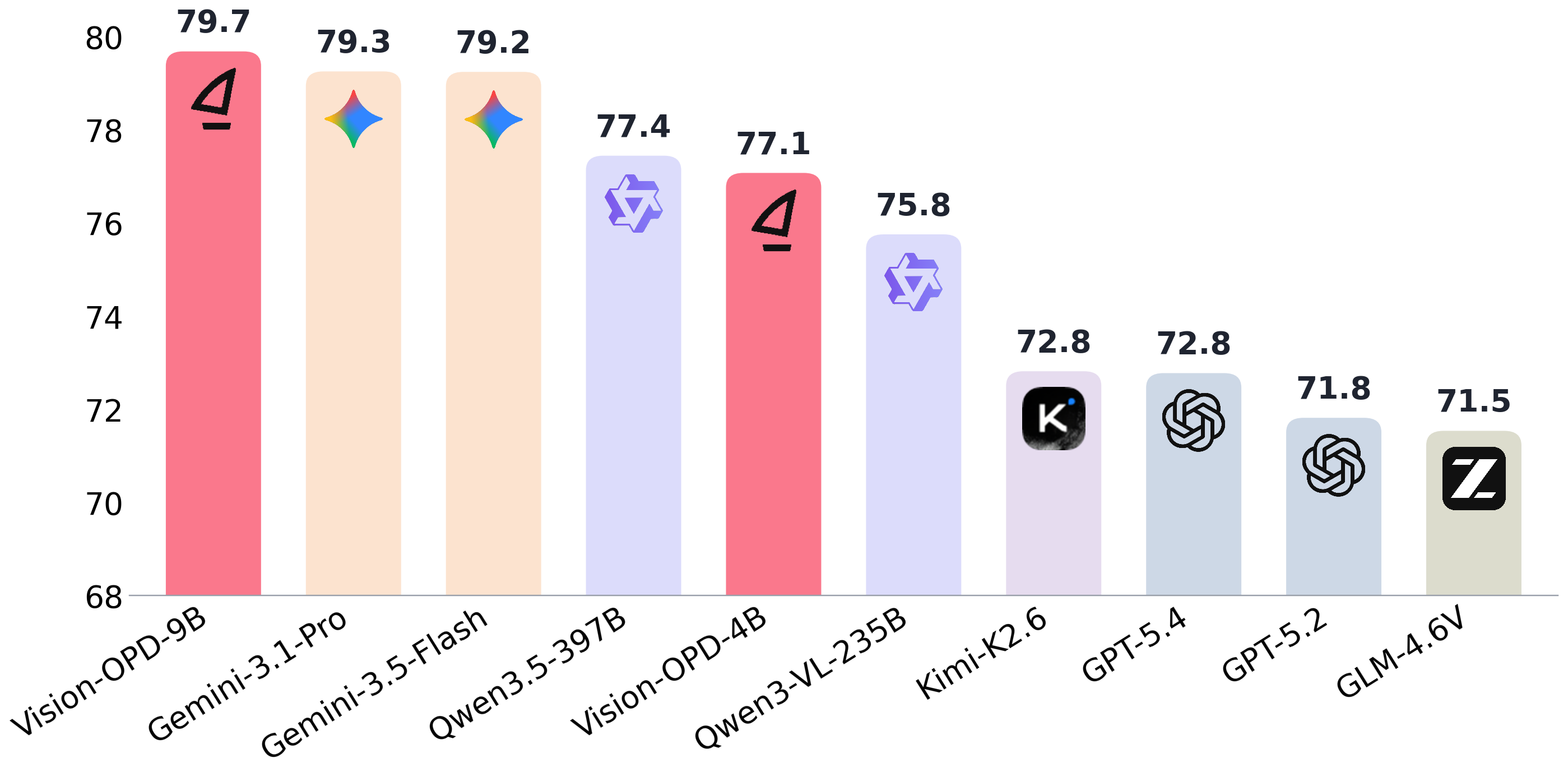
- Beats closed-source Gemini-3.1-Pro (79.25) and Gemini-3.5-Flash (79.24). 超过闭源的 Gemini-3.1-Pro(79.25)、Gemini-3.5-Flash(79.24)。
- Beats far larger open-source models, e.g. Qwen3.5-397B (77.44). 超过体量大得多的开源模型,比如 Qwen3.5-397B(77.44)。
- Beats various "Thinking-with-Images" agentic methods — while Vision-OPD needs only a single forward pass. 也超过各类 "Thinking-with-Images" 智能体方法,而 Vision-OPD 只需一次前向传播。
Vision-OPD-4B also reaches 77.07, showing the method can effectively "pack" fine-grained visual understanding into existing models. Vision-OPD-4B 的平均分也有 77.07,说明 Vision-OPD 确实能把细粒度视觉理解的本事,有效地“装”进现有模型里。
Crucially, it is specialized yet not lopsided: on held-out benchmarks outside the training distribution (MMVP, CV-Bench, MMStar, POPE), it maintains or even improves general perception and reasoning — no "learn the new, forget the old" common to task-specific fine-tuning. The gains do not come at the cost of forgetting. 更难得的是它专精却不偏科:在训练分布之外的基准(MMVP、CV-Bench、MMStar、POPE)上,它保持甚至提升了通用的看图与推理能力,没有出现专项微调常见的“学了新的、忘了旧的”。换句话说,这份提升不是拿遗忘换来的。
Conclusion总结
We present Vision-OPD, a regional-to-global on-policy self-distillation framework for fine-grained visual understanding. The insight is simple: an MLLM's fine-grained bottleneck is often not "can it recognize" but "can it stay focused" — and the model's own privileged perception under a crop can supervise its full-image behavior. From a single model, Vision-OPD derives a crop teacher and a full-image student and runs token-level self-distillation on the student's on-policy trajectories, with no stronger external teacher, no ground-truth labels, no reward verifier, and no inference-time tools. With only ~6.2K fully-auto-synthesized examples, it lifts a 9B model to match or exceed closed-source models, far larger open-source models, and "Thinking-with-Images" agentic methods on fine-grained benchmarks — without sacrificing general ability. 我们提出了 Vision-OPD——一个面向细粒度视觉理解的区域到全局在线自蒸馏框架。它背后的洞见很简单:大模型的细粒度瓶颈,往往不在“认不认得”,而在“盯不盯得住”;而模型自己在裁剪条件下的特权感知,恰好可以拿来监督它的全图行为。Vision-OPD 从同一个模型派生出裁剪老师和全图学生,在学生的在线轨迹上做 token 级自蒸馏,不用更强的外部老师、不用真值标签、不用奖励验证器,推理时也不用任何工具。仅凭约 6.2K 条全自动合成数据,它就让一个 9B 模型在多个细粒度视觉理解基准上,打平甚至超过了闭源模型、更大的开源模型和 "Thinking-with-Images" 智能体方法,同时不丢通用能力。